


Is a Carport Attached to House Right for You?
A carport attached to house is one of the smartest upgrades a homeowner can make — offering vehicle protection, shade, and curb appeal without the cost of a full garage.
Here’s a quick overview of what you need to know:
| Feature | Details |
|---|---|
| What it is | A roofed structure fixed to your home’s exterior wall, covering your driveway or parking area |
| Best materials | Alumawood, galvanized steel, or pressure-treated lumber |
| Typical size | 12–30 ft wide, 20–30 ft long; minimum 8 ft clearance for two cars |
| Permit required? | Almost always — check local building codes and HOA rules first |
| Average cost | Kits start around $1,200; custom builds typically range from $6,000–$8,000+ |
| DIY or pro? | Possible to DIY, but professional installation is strongly recommended for structural safety |
| Key benefit over freestanding | Direct access to your home, better weather protection, and a cleaner, built-in look |
Unlike a freestanding carport sitting elsewhere on your property, an attached carport connects directly to your home — giving you dry, sheltered access to your vehicle no matter the weather. For homeowners in places like Utah and Wyoming, where hail, heavy snow, and intense UV exposure are a real concern, that protection matters a lot.
At Awnings Unlimited, we’ve been designing and installing custom carports and patio covers across Northern Utah since 1976 — including every style of carport attached to house you can imagine, built with industry-leading Alumawood materials and backed by a warranty you can count on. Whether you’re just starting to explore your options or ready to move forward, this guide walks you through everything.
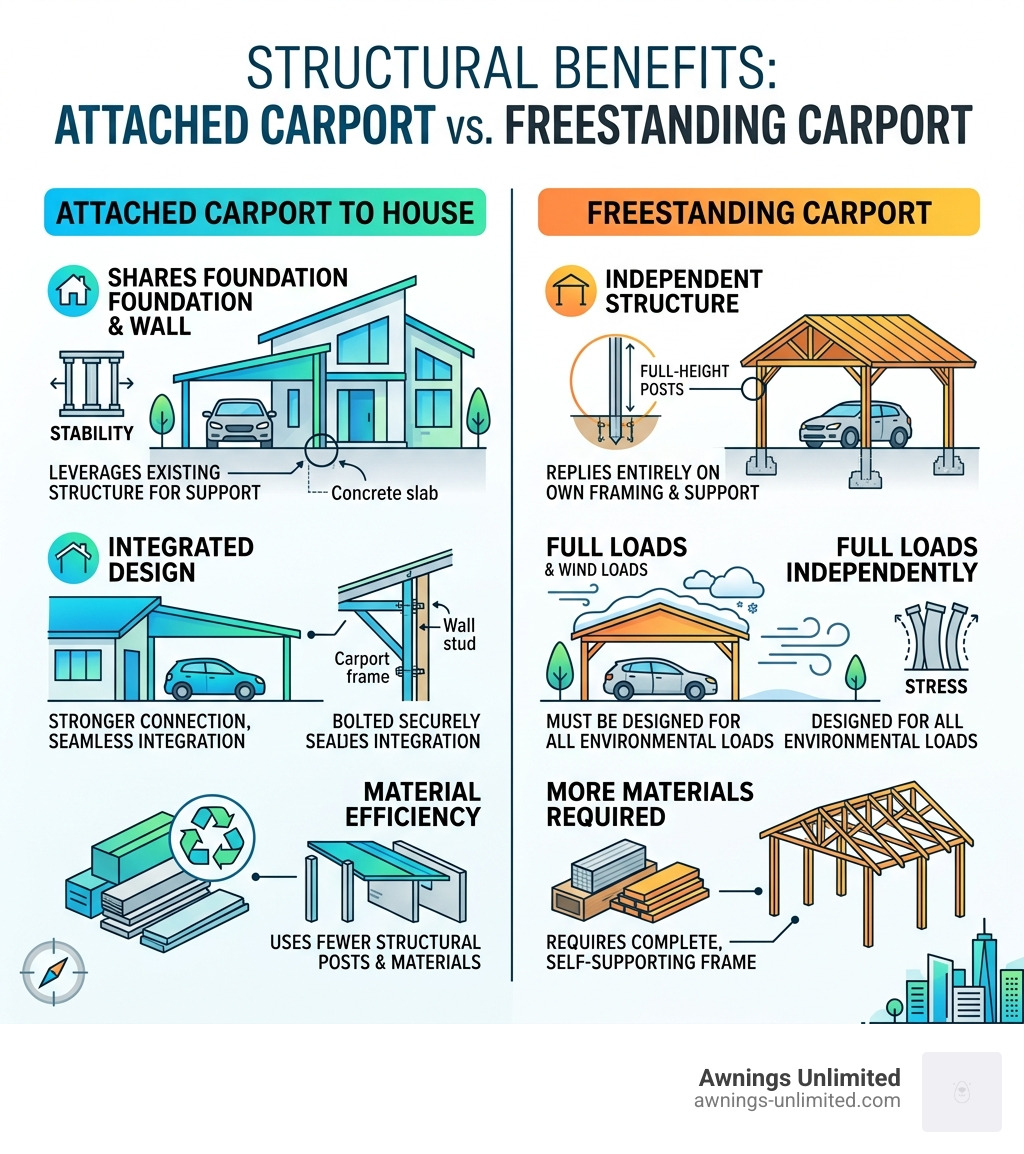
Benefits of a Carport Attached to House vs. Freestanding
When you are deciding between a carport attached to house and a freestanding model, the “attached” version almost always wins on convenience. Because it shares a structural wall with your home, you get a seamless transition from your front door to your driver’s seat. No more sprinting through a Salt Lake City downpour or shoveling a path through the snow just to reach your car.
The Benefits Of Installing A Carport At Home extend beyond just staying dry. An attached structure acts as a thermal buffer for your home. By shading a portion of your exterior wall, it can actually help lower interior temperatures during those scorching July afternoons in Orem or Provo. It also maximizes space efficiency; instead of taking up a chunk of your backyard, it utilizes the existing driveway space right next to your house.
| Feature | Attached Carport | Freestanding Carport |
|---|---|---|
| Home Access | Direct, sheltered entry | Requires walking through elements |
| Space Efficiency | High (uses existing driveway) | Lower (requires dedicated footprint) |
| Structural Support | Uses house frame + posts | Entirely dependent on posts |
| Cost | Often lower (fewer posts needed) | Can be higher due to more materials |
| Aesthetics | Looks like a home extension | Looks like a separate outbuilding |
Enhancing Curb Appeal and Property Value
A well-designed carport attached to house doesn’t look like an afterthought; it looks like it was built with the home. By matching the roof pitch, color palette, and trim of your house, we create architectural harmony that actually boosts your home’s market value. Carports Protect Your Vehicles And Add Value To Homes by providing a functional “garage-lite” experience that many buyers in the Wasatch Front find highly desirable.
Practical Advantages for Utah and Wyoming Climates
In our region, the weather doesn’t play around. In April 2026, we are still seeing the same heavy snow loads and intense UV rays that have challenged homeowners for decades. A custom carport attached to house is engineered to handle these specific stresses. Benefits Of Installing A Carport In Utah include protecting your car’s paint from UV fading and preventing hail damage during spring storms. Plus, having a solid roof attached to the house ensures that rain runoff is directed away from your foundation through integrated gutter systems.
Planning and Permitting for Your Carport Attached to House
Before you pick up a hammer or call an installer, you have to navigate red tape. Every city from Brigham City to Spanish Fork has its own set of rules. You’ll need to check local building codes, zoning laws, and—perhaps most importantly—your HOA guidelines.
Most municipalities require a permit for any permanent structure attached to a dwelling. These permits ensure your carport meets safety standards for wind resistance and snow loads. You can often find Building Permit Information Sheets on your city’s official website to see exactly what’s required. For a deeper dive into the prep work, check out our Carport Installation 101 Your Go To Guide Before You Start.
Measuring for a Seamless Carport Attached to House Fit
Accuracy is everything. Most carports are between 12 and 30 feet wide and 20 to 30 feet long. If you’re parking two cars, you’ll want at least an 8-foot beam clearance to avoid feeling cramped.
When measuring, don’t just look at the ground. Look up at your eaves. You need adequate height under the house overhang to attach the structure. If your house has a low roofline, we may need to adjust the roof pitch of the carport to ensure proper drainage while maintaining enough head clearance. You can find various Carport Attached to the House Plans to visualize how these dimensions translate to a real build.
Material Selection: Alumawood vs. Steel and Wood
Choosing the right material is a balance of aesthetics and maintenance.
- Alumawood: This is our specialty at Awnings Unlimited. It gives you the beauty of cedar with the durability of aluminum. It won’t rot, peel, or host termites, making it perfect for the dry Utah climate.
- Steel: Often used in Custom Carports A Stylish Solution For Vehicle Protection, galvanized steel is incredibly strong and fire-resistant, though it can sometimes look more “industrial” than residential.
- Wood: Pressure-treated lumber is a classic choice. It’s sturdy and customizable, but it requires regular staining or painting to prevent weather damage.
Installation Essentials: Anchoring and Structural Integrity
The most critical part of a carport attached to house is the connection point. We use a ledger board—a heavy-duty piece of lumber or metal—bolted directly into the house’s structural frame.
Warning: Never bolt a carport directly into just the brick or siding. Brick is a veneer and cannot support the weight of a carport roof, especially when it’s covered in six inches of heavy Utah snow. We ensure the bolts reach the rim joists or studs of the house for a secure hold.
On the “open” side, your posts need a solid foundation. This usually involves digging footings at least 24 inches deep (or down to the frost line) and securing the posts with concrete. If you’re curious about the mechanics, How To Build a Carport Attached To The Side Of Your House provides a great technical breakdown. However, because of the engineering involved, many homeowners find that the Carports And Benefits Of Professional Installation far outweigh the risks of a DIY failure.
Proper Roof Design and Integration
Your roof choice defines the look of the structure.
- Skillion (Single Slope): Modern, simple, and excellent for directing water away from the house.
- Gable (A-Frame): Traditional and matches most residential rooflines perfectly.
We space rafters typically 24 inches on center (though sometimes 16 inches for heavy snow areas) and use hurricane ties to keep the roof attached during high winds. One pro tip: we often add blocking between rafters to prevent birds from nesting in the eaves—a common headache with open-air structures. You can even design a Pergola Carport Attached To House if you want a more decorative, airy feel.
Avoiding Common Mistakes with a Carport Attached to House
The biggest mistake we see? Underestimating the load. A “lightweight” kit might look great in the summer, but it can buckle under a Wyoming winter. Other common pitfalls include:
- Poor Drainage: Failing to install gutters or sloping the roof toward the house.
- Incorrect Fasteners: Using standard screws instead of galvanized lag bolts.
- Ignoring Setbacks: Building too close to the property line, which can lead to fines or forced removal.
Read more on how to avoid these in Carport Installation Everything You Need To Know Before You Start.
Frequently Asked Questions about Attached Carports
Should I DIY or hire a professional for installation?
While a DIY kit can save money upfront (Arrow kits start around $1,199), the complexity of attaching a structure to your home’s frame is high. Professional installers handle the engineering certifications, permit applications, and specialized tools required for a safe build. When you Maximize Your Space The Benefits Of A Custom Carport with a pro, you also get a warranty that protects your investment for years.
How much does an attached carport cost in 2026?
As of April 2026, material prices have stabilized, but labor remains a factor. A basic metal kit might cost $1,200 to $2,000. However, a custom-built, professionally installed Alumawood or wood carport attached to house typically ranges from $6,000 to $8,000+. Factors influencing the price include the size, the complexity of the roofline, and whether you need a new concrete pad (apron) poured.
What maintenance is required for long-term durability?
If you choose Alumawood, maintenance is almost zero—just a quick spray with a hose once a year. For wood carports, you’ll need to inspect the finish every 2–3 years and re-stain as needed. Regardless of the material, you should clear the gutters every autumn and check the fasteners once a year to ensure everything remains tight and secure.
Conclusion
Adding a carport attached to house is an investment in your home’s future and your daily comfort. At Awnings Unlimited, we pride ourselves on being the Wasatch Front’s premier choice for structural awnings and patio covers. From our base in Salt Lake City, we’ve spent nearly 50 years helping families in Northern Utah and Wyoming protect their vehicles with style and durability.
Ready to upgrade your home with a structure that’s built to last? Whether you’re in Layton, Draper, or Park City, we’re here to help. Request a Quote for Your Custom Carport today and let us show you why Alumawood is the gold standard for Utah homes in 2026.