


Why Understanding Pergola Material Costs Matters for Your Outdoor Investment
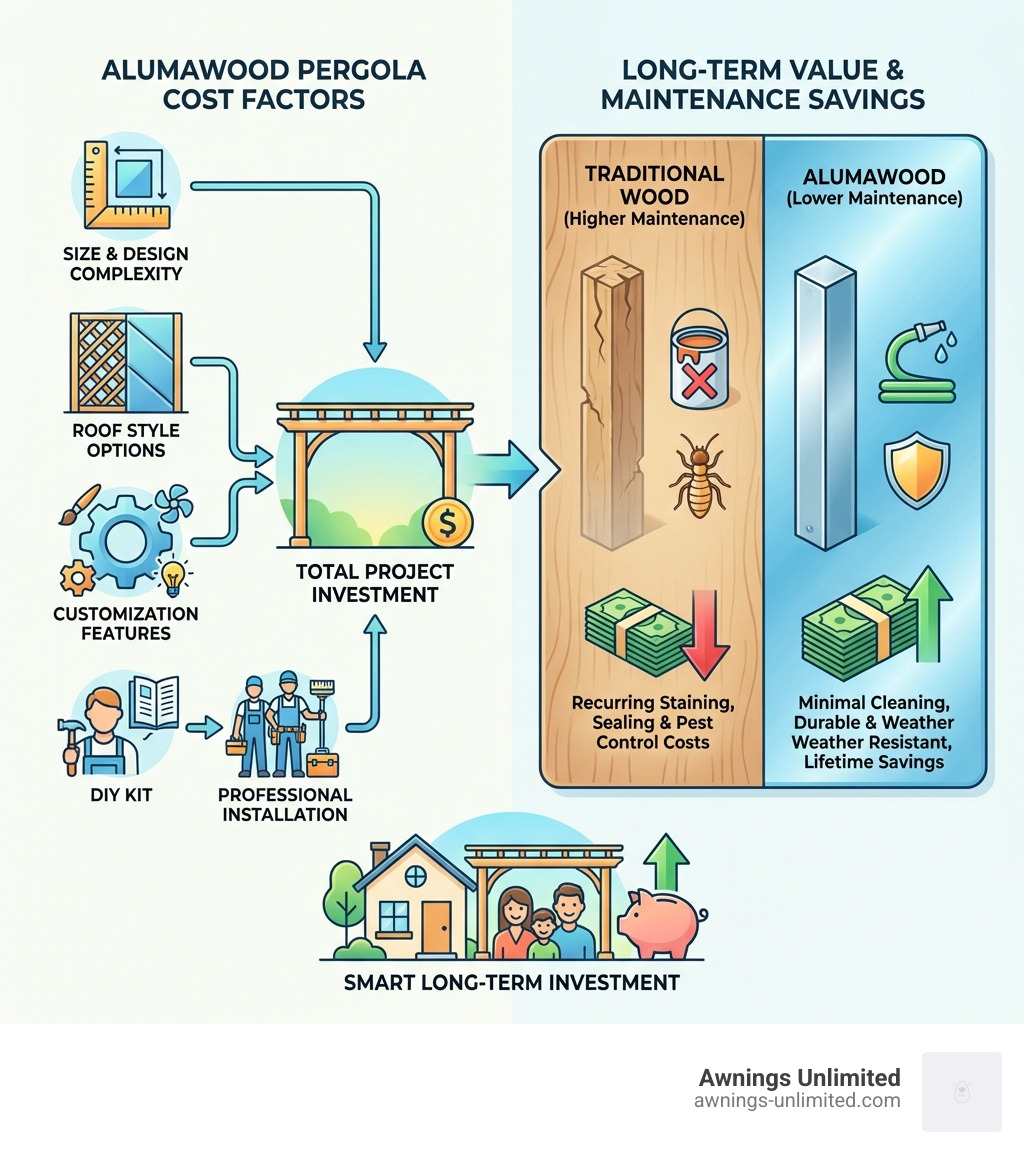
Alumawood pergola cost depends on several key factors, but homeowners can expect a more predictable investment compared to traditional wood. Here’s what influences the total price:
- Size and design complexity – Larger structures and custom features increase material needs
- Roof style – Lattice designs differ from solid or insulated panel systems
- Installation method – Professional installation versus DIY kits
- Customization – Color choices, rafter tail styles, lighting, and fans
- Site preparation – Permits, foundation work, and local building codes
- Long-term value – Lower maintenance requirements reduce lifetime ownership costs
Creating a comfortable outdoor living space requires balancing upfront investment with long-term durability. Traditional wood pergolas may appear less expensive initially, but they demand regular staining, sealing, and pest control. Alumawood offers the authentic look of wood grain without the ongoing maintenance headaches—no rotting, warping, or termite damage to worry about.
The material you choose shapes not just your budget today, but your time and money spent maintaining the structure for decades. Aluminum-based pergolas resist harsh weather, from intense summer sun to heavy winter snow, while maintaining their appearance with minimal care. This durability makes them particularly valuable in regions with challenging climates.
As Awnings Unlimited, we’ve been installing custom Alumawood pergolas and patio covers throughout Salt Lake City and Northern Utah since 1976, giving us decades of experience helping homeowners understand Alumawood pergola cost and make informed decisions. Our family-owned business specializes in durable structural awnings and patio covers that withstand Utah’s harsh winters and provide comfortable outdoor spaces all summer long.
Key Factors Influencing Your Outdoor Structure Investment
When we sit down with families in Salt Lake County or along the Wasatch Front, the first thing we discuss is that a pergola isn’t just a “product”—it’s an extension of your home. Several variables determine the final investment required for your project.
Project Size and Scale
It sounds obvious, but the footprint of your pergola is the primary driver of the Alumawood pergola cost. However, it is not always a linear relationship. Larger structures require more substantial support beams and potentially more columns to ensure structural integrity. In areas like Ogden or Park City, where snow loads can be significant, the size of the structure also dictates the heavy-duty nature of the aluminum components required to meet safety standards.
Site Preparation and Foundation
Before we can even think about the beautiful wood-grained aluminum, we have to look at what’s under your feet. Are we mounting to an existing concrete patio, or do we need to pour new footings? If your backyard in Draper or Sandy has a significant slope, site leveling might be necessary. Proper Custom Pergola Design accounts for these foundational needs early on to avoid “surprise” expenses later.
Local Building Codes and HOA Approvals
Every municipality from Logan to Provo has its own set of rules. Some cities require specific engineering stamps for wind and snow loads, while others have strict setback requirements. Furthermore, if you live in a managed community, your HOA might have opinions on everything from the color of the pergola to the style of the rafter tails. We handle the heavy lifting of navigating these regulations, but the requirements of your specific zip code can influence the overall project complexity.
Structural Engineering
Alumawood isn’t just “flimsy aluminum.” It is a precision-engineered system. Depending on the span of your patio—say you want a wide-open view without a forest of posts—we may need to use double-beam construction or heavy-duty headers. This engineering ensures your pergola doesn’t just look good on day one but stays standing through a decade of Utah winters.

Customization Options and Alumawood Pergola Cost
One of the reasons we love working with Alumawood is that it allows for a level of personalization that traditional metal covers simply can’t match. However, each choice you make to “make it yours” will play a role in the final Alumawood pergola cost.
- Color Selection: While standard colors are beautiful and designed to match most home exteriors, choosing premium or multi-toned finishes can add to the aesthetic value and the material investment.
- Rafter Tail Styles: Do you prefer the classic look of a Scallop tail, or something more modern like a Miter or Bevel cut? These small architectural details define the “vibe” of your outdoor space.
- Integrated Lighting and Fans: Most of our clients in the Salt Lake Valley choose to add electrical packages. Since Alumawood beams are hollow, we can hide all the wiring for LED puck lights or a heavy-duty ceiling fan. This turns a daytime patio cover into a 24/7 outdoor living room.
- Privacy Walls and Screens: If you have neighbors close by in a suburban area like South Jordan, adding a lattice privacy wall to one side of your pergola is a popular upgrade.
If you are ready to see how these options fit into your vision, you can Shop Patio Accessories or speak with our design team to get a clear picture of how customization affects your specific project.
Comparing Alumawood to Traditional Wood
We often hear the question: “Why should I choose aluminum when I can just buy wood at the local lumber yard?” It’s a fair question! Wood has a classic appeal, but when you look at the Pergola Cost Breakdown, the “cheaper” option often ends up being the most expensive over time.
| Feature | Alumawood Pergola | Traditional Wood Pergola |
|---|---|---|
| Initial Investment | Moderate to High | Low to Moderate |
| Maintenance | Minimal (Soap & Water) | High (Staining/Sealing every 2-3 years) |
| Termite/Pest Resistance | 100% Immune | Susceptible to infestation |
| Weather Resistance | Won’t rot, warp, or crack | Cracks and warps over time |
| Lifespan | 20-30+ Years | 10-15 Years (with heavy maintenance) |
| Fire Resistance | Non-combustible | Highly combustible |
While a cedar or redwood pergola looks stunning the day it’s finished, Utah’s climate is notoriously hard on natural timber. The dry air causes wood to shrink and crack (checking), while the intense UV rays at our high altitude bleach the color and break down the fibers. Within just a few years, a wood pergola requires a full weekend of sanding and re-staining—a cycle that repeats indefinitely.
In contrast, Alumawood is “set it and forget it.” It provides the embossed texture of wood grain but is fundamentally a high-grade aluminum. It doesn’t absorb moisture, so it won’t rot during the spring thaw, and it won’t host a colony of carpenter bees.
Long-Term Value and Alumawood Pergola Cost
When evaluating the Alumawood pergola cost, we encourage our neighbors in Bountiful and Layton to think about “Total Cost of Ownership.” If you spend a few hundred dollars every two years on stains, brushes, and professional help for a wood structure, those costs quickly eclipse the initial premium paid for Alumawood.
By choosing Alumawood Products Salt Lake City, you are investing in the Aluma-Shield® paint system. This isn’t just standard paint; it’s a high-performance coating infused with Teflon® surface protector. It repels dust, dirt, and oil, meaning a quick spray with a garden hose is usually all the maintenance you’ll ever need.
Furthermore, a professionally installed Alumawood structure is a permanent home improvement. It adds tangible curb appeal and resale value to your home. When a home inspector sees a rotting wood pergola, it’s a liability; when they see a pristine Alumawood cover, it’s an asset.
Design Variations: Lattice vs. Solid Roof Systems
Not all pergolas are created equal. The “style” of the roof is one of the most significant factors in both the Alumawood pergola cost and how you will use the space.
The Laguna Lattice
The Laguna lattice is what most people think of when they hear “pergola.” It features cross-hatched rafters that provide “filtered” shade.
- Sun Protection: Typically provides 40% to 60% shade.
- Airflow: Excellent. Heat rises through the lattice, keeping the patio cool.
- Aesthetic: Very traditional and neat.
- Best For: Homeowners who want a garden-like feel and don’t mind a little rain getting through.
The Newport Solid Roof
If you want 100% protection from the elements, the Newport system is the way to go. It uses solid interlocking panels to create a watertight seal.
- Weather Protection: 100% waterproof. You can sit outside during a summer thunderstorm in West Jordan and stay completely dry.
- Protection for Furniture: Your outdoor sofa and rug will last much longer under a solid roof.
- Investment: Generally, a solid non-insulated roof is a very cost-effective way to get full coverage.
Insulated Solid Roof Systems
For the ultimate in comfort, we offer insulated panels. These feature a high-density foam core sandwiched between aluminum skins.
- Thermal Resistance: This is a game-changer for Utah summers. It blocks the “radiant heat” that can make a standard metal roof feel like an oven.
- Noise Reduction: The foam core dampens the sound of rain, making it much quieter than a single-layer metal roof.
- Structural Strength: These panels are incredibly strong, often allowing for longer spans and fewer support posts.
Choosing between these Alumawood Products SLC depends on your lifestyle. Do you want to grow climbing vines (Lattice), or do you want an outdoor kitchen that stays dry year-round (Solid)?
Understanding the Total Alumawood Pergola Cost
It is tempting to look at the price of a DIY kit and think that’s the final number. However, the “total” Alumawood pergola cost involves several layers of professional service that ensure your investment is protected.
Professional Installation vs. DIY Kits
While we offer DIY options for the handy homeowner, most of our clients prefer professional installation. Why?
- Structural Integrity: We ensure every post is plumb and every beam is level, which is critical for the longevity of the structure.
- Warranty Protection: Many manufacturer warranties are specific about how the product is installed. Professional installation ensures you stay within those guidelines.
- Safety: Handling large aluminum beams on a ladder is a two- or three-person job. Our teams have the equipment and insurance to do it safely.
Labor and Delivery Logistics
Shipping long aluminum extrusions requires specialized freight. When we handle your project, we take care of the delivery and the logistics of getting the materials to your backyard in Saratoga Springs or Heber City without damage. Labor expenses also cover the “little things” like flashing the ledger board to your house to prevent leaks—a step that, if skipped, can cause thousands of dollars in water damage to your home’s rim joist.
The Value of a Leading Warranty
We believe in The Importance of Warranties. Awnings Unlimited provides a limited lifetime warranty on our Alumawood products. This covers peeling, cracking, and structural failure. When you factor this into the Alumawood pergola cost, you’re essentially buying “shade insurance” for as long as you own your home.
Frequently Asked Questions about Alumawood Pergolas
Can you install solar panels on an Alumawood patio cover?
Yes! Most solid-roof Alumawood systems are sturdy enough to support the weight of solar panels. However, it is vital to have the structure engineered for the specific weight of the panels and the mounting hardware. We recommend a consultation to ensure your pergola is reinforced correctly to handle the extra load without sagging.
Is it safe to stand on an Alumawood roof system?
Generally, no. While Alumawood is incredibly strong for its weight, it is not designed to be a “walking surface.” The panels are designed to support “live loads” like snow, but the concentrated weight of a person can dent the aluminum or damage the interlocking seals. If you need to clean the roof or clear debris, we recommend using a ladder or a long-handled soft brush from the ground.
How does Alumawood compare to wood in terms of maintenance?
There is almost no comparison. A wood pergola in the Utah desert needs attention every year or two. Alumawood needs a bath. We recommend rinsing your pergola with a garden hose twice a year to remove Salt Lake Valley dust and pollen. For stubborn spots, a bucket of water with a mild dish soap and a soft-bristled brush will make it look brand new again. You will never have to scrape, sand, or paint—ever.
Conclusion
At the end of the day, the Alumawood pergola cost is an investment in your quality of life. Whether you’re hosting a family BBQ in West Valley City or enjoying a quiet morning coffee in Alpine, the right structural awning makes those moments possible.
By choosing Alumawood, you’re opting for a material that mimics the timeless beauty of wood but offers the modern resilience of aluminum. You’re trading weekends spent with a paintbrush for weekends spent with your family.
As a family-owned business serving Utah and Wyoming since 1976, Awnings Unlimited is proud to offer custom solutions that fit your budget and your backyard. From the initial design to the final screw, we are committed to providing durable, beautiful structures that stand the test of time.
If you’re ready to transform your outdoor space, we invite you to Explore our Alumawood Products or contact us for a personalized consultation. Let’s build something beautiful together!