

Why Awnings and Canopies Are a Smart Investment for Your Home
Awnings and canopies are permanent shade structures that protect your outdoor living space from sun, heat, and weather — while adding real value to your home.
Here’s a quick breakdown of what you need to know:
| Feature | Awnings | Canopies |
|---|---|---|
| Attachment | Wall-mounted to your home | Freestanding with support posts |
| Best for | Patios, windows, doors | Open yards, large patios, commercial use |
| Structure | Fixed or retractable | Fixed |
| Materials | Acrylic fabric, aluminum, Alumawood | Aluminum, steel, Alumawood |
| Key benefit | Shades your home’s exterior walls | Covers open areas without a wall anchor |
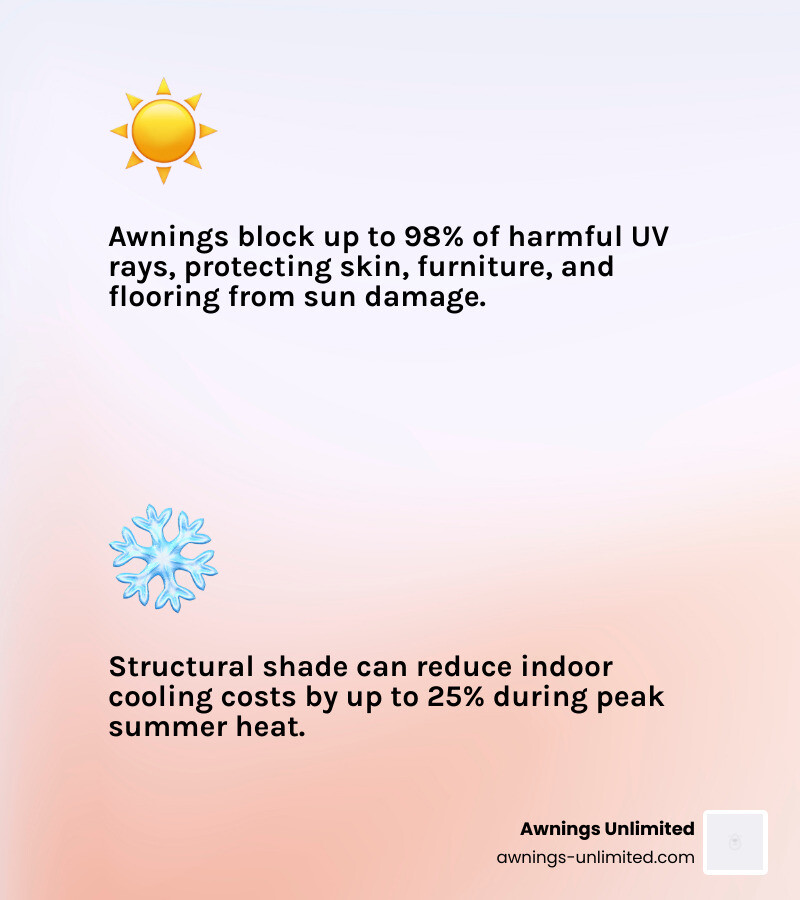
Both types block harmful UV rays, lower outdoor temperatures, and can cut cooling costs by up to 25%. The right choice depends on your space, climate, and how you use your outdoor area.
Choosing the right shade structure isn’t always simple. There are dozens of material options, mounting styles, and product types — and in many Canadian cities and across North America, local building codes add another layer of complexity. Whether you’re a homeowner looking to extend your living space outdoors or protect your property from the elements, understanding your options is the first step.
At Awnings Unlimited, we’ve been helping homeowners across Northern Utah find the right awning and canopy solutions since 1976 — nearly five decades of hands-on installation experience with durable, custom-built shade structures. In this guide, we’ll walk you through everything you need to make a confident, informed decision.
Understanding the Differences Between Awning and Canopies
When you start shopping for shade, the terms “awning” and “canopy” are often used interchangeably, but in professional installation, they serve very different structural roles. Understanding these differences is the first step in choosing the right awning for your home.
Awnings: The Wall-Mounted Classic
An awning is a secondary covering attached to the exterior wall of a building. It typically consists of a frame (aluminum or steel) covered with fabric or metal. Because they are cantilevered, most residential awnings don’t require support posts, allowing for an unobstructed view and clear floor space underneath.
We often recommend custom outdoor awnings for homeowners in Salt Lake City who want to shade specific windows or a patio directly adjacent to the house. These structures can be fixed (permanent) or retractable. While retractable models offer flexibility, there is a strong case to be made for why a fixed awning is a smart home investment; they are incredibly sturdy, require less mechanical maintenance, and can handle the heavy snow loads we see along the Wasatch Front.
Canopies: Freestanding Versatility
A canopy, by definition, is a freestanding structure. While it can be placed next to a building, it is supported by at least two (and usually four or more) posts. This makes canopies the ideal choice for large, open areas like a backyard pool deck or a commercial dining space where there isn’t a suitable wall for mounting.
In our experience serving Utah and Wyoming, canopies are the heavy-hitters of the shade world. Because they are anchored into the ground or a concrete pad, they can achieve much larger projection distances than a wall-mounted awning.

Popular Types and Materials for Structural Shade
The longevity of your awning and canopies depends almost entirely on the materials used. In May 2026, the market offers a variety of structural solutions designed for permanent installation. For a long-term investment, you need to look for high-quality materials engineered for durability.
Material Comparison Table
| Material | Durability | Maintenance | Best Use Case |
|---|---|---|---|
| Aluminum/Alumawood | Extremely High | Very Low | Permanent patio covers, carports |
| Acrylic Fabric | High | Moderate | Retractable and fixed window awnings |
| Polycarbonate | Moderate | Low | Door awnings, modern translucent covers |
For those looking for durable awnings in Utah, we specialize in Alumawood. It provides the beauty of wood with the structural integrity of embossed aluminum, meaning it won’t rot, peel, or require repainting.
Operation and Technology
Modern shade structures have come a long way from the old manual hand-cranks. Today, you can choose:
- Motorized Operation: With the push of a button or a smartphone app, your awning extends or retracts.
- Sensors: High-end models feature wind and sun sensors. If the wind picks up beyond a safe threshold, the unit retracts automatically to prevent damage.
- Manual Cranks: Still a reliable, cost-effective option for smaller units or areas without easy electrical access.
For year-round use, a fixed structural solution is necessary to withstand local weather conditions.
Choosing the Right Awning and Canopies for Your Climate
Your geography dictates your shade needs. In Northern Utah and Wyoming, we deal with two extremes: intense desert heat and heavy winter snow.
When we talk about awnings for every season, we emphasize snow load capacity. A standard fabric awning may need to be retracted or even taken down in the winter to prevent the frame from bending under the weight of a January storm. Conversely, our solid-top Alumawood structures are engineered to stay up 365 days a year, providing “anchored in awesome” protection regardless of the forecast.
In arid conditions like those found in Southern Utah or the high deserts of Wyoming, UV resistance is the priority. High-quality woven acrylics, such as Sunbrella, are engineered to resist fading and mold while blocking nearly all harmful rays.
Key Benefits: UV Protection and Energy Efficiency
Installing awning and canopies isn’t just about fashion; it’s about function and finance. One of the most significant reasons awnings are a must-have for Utah homes is the immediate impact on your utility bills.
Energy Savings and Temperature Control
Did you know that shading your windows and exterior walls can cut cooling costs by up to 25%? In the peak of summer, the sun’s rays hitting your glass windows turn your home into a greenhouse. By stopping that heat before it enters your home, you take the strain off your air conditioning system. A properly placed awning can reduce the temperature of your outdoor living space by 10 to 20 degrees, making it usable even when the thermometer hits triple digits.
UV Blockage and Furniture Preservation
UV rays are the primary cause of fading for interior carpets, hardwood floors, and expensive patio furniture. Quality structural shade systems block up to 98% of harmful UV rays.
When you transform your outdoor space, you aren’t just creating a place to grill; you’re creating a protected environment for your family and your investments.
Enhancing Commercial Spaces with Awning and Canopies
For business owners, the benefits of a commercial awning go beyond shade. A well-designed storefront awning increases foot traffic by providing a dry, cool place for customers to linger. It also serves as 24/7 signage. With digital printing options, you can add your logo and branding directly to the fabric, creating a professional image that stands out on the street.
Installation Requirements and Local Building Codes
Before you pick out a color, you need to understand the rules. Whether you are in Salt Lake City or looking at regulations in major hubs like Montréal or Vancouver, building codes are there for safety.
Permits and Regulations
In many jurisdictions, a permit is required if the awning exceeds a certain size or projects over public property. For example, in Montréal, permit fees are often based on the value of the work (roughly $9.80 per $1,000), with minimum fees for residential and commercial properties. They also have strict rules about projection distances—usually limited to 1.5 meters in residential areas—and minimum distances from property lines (often 1.2 meters).
In our local Awnings Salt Lake City Utah Guide, we highlight that professional installation is key to staying compliant with local codes. We handle the heavy lifting, ensuring that the mounting points are structurally sound and that the structure meets local wind and snow load requirements.
Fire Safety and Certifications
For commercial applications especially, fire safety is paramount. Look for fabrics that meet CPAI-84, NFPA-701, or CAN/ULC-S109 fire-resistance standards. These certifications ensure that the material is flame-retardant and safe for use in public spaces or near outdoor kitchens.
Heritage and Aesthetic Standards
If you live in a historic district—whether it’s the Avenues in Salt Lake or a heritage site in a Canadian city—there may be additional restrictions on colors and materials. Polycarbonate or plastic awnings are often prohibited in these areas in favor of traditional canvas or flexible materials that maintain the architectural harmony of the neighborhood. Residential awnings boost curb appeal, but only if they complement the home’s original character.
Maintenance Tips for Long-Lasting Outdoor Structures
A high-quality awning and canopy system is an investment, and like any investment, it requires a little TLC to reach its full lifespan. Most premium awnings are designed to last 10 to 15 years, but with proper care, they can go even longer.
Fabric Care and Cleaning
- Regular Brushing: Use a soft-bristled brush to remove loose dirt and debris before it becomes embedded in the fabric.
- Gentle Washing: Once a year, wash the fabric with a mixture of mild soap and lukewarm water. Avoid harsh detergents or power washers, which can strip away the water-repellent coating.
- Mildew Prevention: Mildew doesn’t grow on acrylic fabric itself, but it will grow on the dirt trapped in the fibers. Keeping the awning clean is the best defense. Never roll up a fabric awning while it is wet; allow it to air dry completely first.
Frame Inspection
Periodically check the metal frame for any signs of loose bolts or corrosion. For those with durable awnings in Utah, our Alumawood structures are virtually maintenance-free, but it’s still a good idea to spray them down with a garden hose occasionally to remove dust and salt buildup.
Seasonal Adjustments
If you have a manual or motorized retractable awning, ensure the tracks are clear of debris. For fixed structures, check the drainage gutters to ensure autumn leaves aren’t causing water to back up, which can lead to unnecessary weight and potential leaks.
Frequently Asked Questions about Shade Structures
Do I need a permit for a retractable awning?
In most residential areas of Utah, a standard retractable awning that doesn’t overhand a public sidewalk typically does not require a building permit. However, local HOA rules often apply. In larger cities like Montréal, a permit is almost always required for any new installation or significant replacement.
How long do structural awnings last?
A high-quality fixed aluminum or Alumawood awning can last 20 to 30 years with minimal maintenance. Fabric awnings typically last 10 to 12 years before the cover needs replacing, though the metal frames can last much longer.
Can structural awnings handle heavy snow?
Only if they are specifically engineered for it. Most retractable fabric awnings cannot handle snow and must be retracted during the winter. Our fixed Alumawood patio covers, however, are designed to withstand the heavy, wet snow typical of Northern Utah and Wyoming winters.
Conclusion
Finding the perfect balance between style, durability, and protection is the key to enjoying your outdoor space. Whether you are looking for a simple window covering to lower your energy bills or a massive freestanding canopy to host summer gatherings, the right awning and canopies will transform how you experience your home.
At Awnings Unlimited, we take pride in being a family-owned business that has served the Wasatch Front since 1976. From Salt Lake City and Provo to Ogden and Park City, we provide professional installation and the highest-quality Alumawood materials to ensure your shade lasts for decades.
Ready to upgrade your outdoor living? Check out our Complete Guide to Patio Covers or contact us today to schedule your consultation. We’ve got you covered—literally!